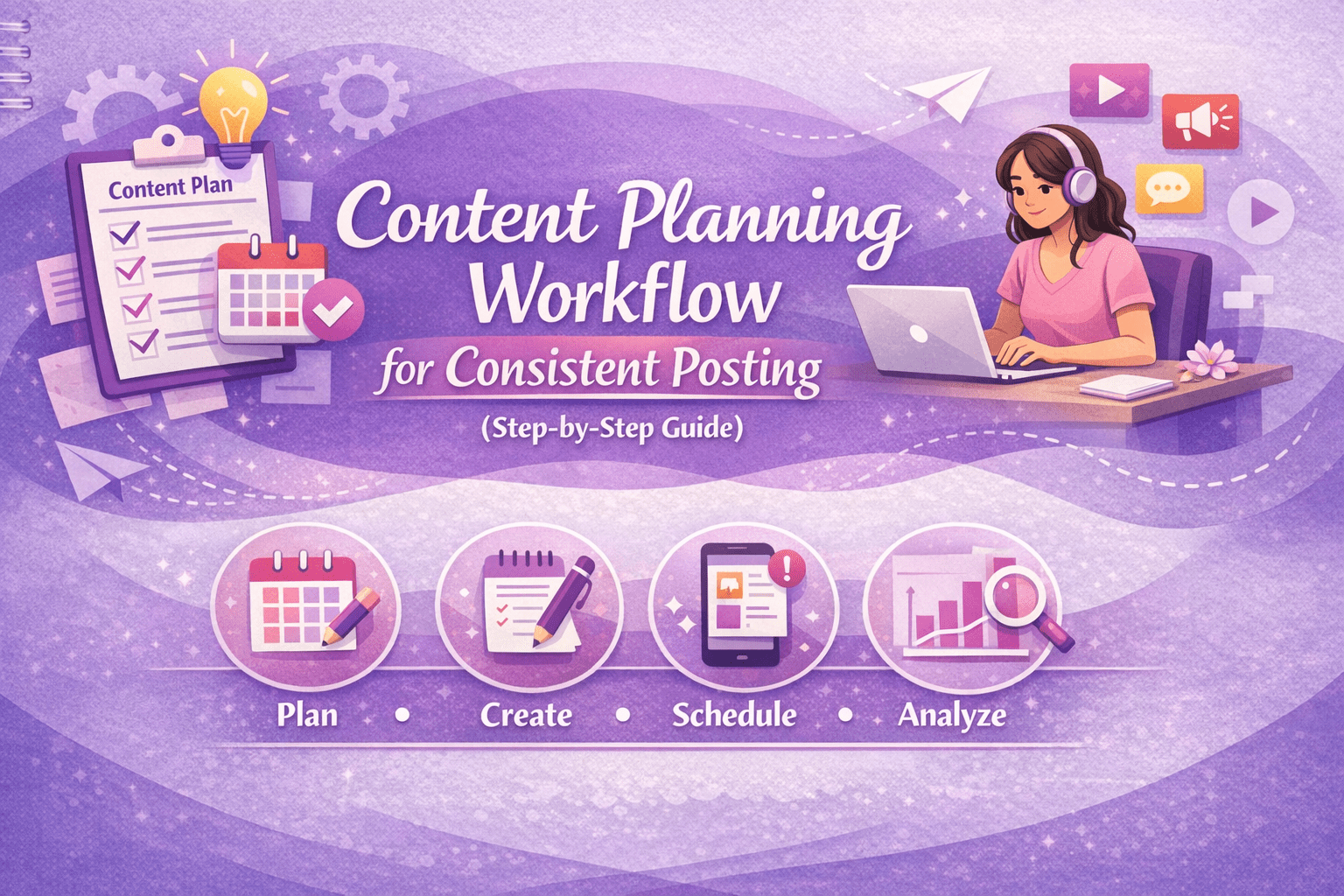
A Step-by-Step Guide for Business Owners, Creators & Startups
Let’s be real: if posting on social media feels random, rushed, or like you’re performing some kind of daily improv show — you don’t have a motivation problem. You have a workflow problem.
Many entrepreneurs fall into the same trap: they show up to create content with the energy of someone who just remembered they have a dentist appointment in 20 minutes. No plan. No system. Just vibes and caffeine. The result? Burnout, ghosting your own audience for weeks at a time, and wondering why leads aren’t rolling in.
Here’s the truth: the solution isn’t to post more. It’s to post smarter — with a repeatable system that removes the guesswork and brings back your sanity.
In this guide, you’ll get a step-by-step content planning workflow you can actually stick to — no overwhelm required.
Why You Need a Content Workflow
A structured workflow isn’t just a productivity hack. It’s the difference between content that converts and content that just… exists. Here’s what a solid system does for you:
- Saves you hours every single week
- Eliminates last-minute panic posting (we’ve all been there)
- Keeps your messaging consistent and on-brand
- Lets you repurpose content strategically instead of starting from scratch
- Aligns your content with your actual business goals
Bottom line: Consistency builds trust. Trust drives sales. And a workflow builds consistency.
Step 1: Clarify Your Content Pillars
Before you plan a single post, you need to know what you actually stand for — and no, “everything” is not an answer.
Define 3–5 content pillars: the core themes that anchor your entire content strategy. Think of them as the lanes you stay in so you stop randomly swerving into topics that have nothing to do with your business. For example:
- Business systems
- Productivity
- Automation
- Virtual assistant support
- Client experience
Content pillars prevent the dreaded 3 a.m. spiral of ‘what do I even post tomorrow?’ They keep your messaging tight and aligned with your offers.
Step 2: Plan Monthly Topics
Stop trying to plan content day by day. That’s like grocery shopping three times a day because you don’t know what you want for dinner — exhausting and expensive.
Instead, zoom out and plan by month. Assign each week a focus that ties back to your pillars. Example:
- Week 1 → Systems
- Week 2 → Productivity
- Week 3 → Automation
- Week 4 → Delegation
This keeps your content connected and progressive rather than a random assortment of thoughts. If you’re actively building authority in a niche, your monthly plan should also align with your blog posts, launches, and services.
Step 3: Batch Content Creation
Batching is the productivity strategy that makes people say ‘wait, how are you posting every day?’ — without actually posting every day in real time.
The old (exhausting) way: Create → Post → Panic → Repeat. Every. Single. Day.
The better way: Plan once → Create 5–10 posts in one focused session → Schedule and walk away.
Batching reduces decision fatigue, gets you into a creative flow state, and frees up your brain for actual business work — you know, the stuff that pays the bills.
Step 4: Repurpose Strategically
Here’s a concept that will change your life: one piece of content is not just one piece of content.
A single long-form blog post can become:
- 3 Pinterest pins
- 1 Instagram carousel
- 2 short-form videos
- 1 email newsletter
- 1 Threads post
That’s five platforms, multiple touchpoints, and way more visibility — from one idea. Repurposing multiplies your reach without multiplying your effort. If you haven’t streamlined your systems yet, that’s your real first step.
Step 5: Schedule and Automate
You did the hard work. Now let the tools do their job.
Scheduling tools exist so you don’t have to be glued to your phone at 9 a.m. on a Tuesday to hit “post.” Load everything in advance and let automation handle the delivery. What you get:
- Consistent posting without daily manual effort
- Time back in your calendar
- A professional, reliable presence — even when you’re on vacation
Automation removes the daily posting pressure that quietly drains your energy and focus.
Step 6: Track and Improve
A workflow without a review loop is just organized chaos. You need to close the feedback loop — or you’ll keep posting into the void hoping something sticks.
At the end of each month, spend 30 minutes analyzing:
- Which posts performed best?
- What drove clicks or saves?
- What topics attracted DMs or inquiries?
Use that data to refine your next month’s plan. Over time, this feedback loop turns your content strategy from a guess into a science.
Sample Weekly Content Workflow
Here’s what a simple, repeatable week looks like in practice:
- Day 1: Plan topics for the week
- Day 2: Create graphics and write captions
- Day 3: Write your blog post or long-form content
- Day 4: Repurpose into short-form content
- Day 5: Schedule everything and step away
Simple. Repeatable. Sustainable.
Common Content Mistakes to Avoid
Let’s call out the habits that are quietly sabotaging your content strategy:
- Posting without a strategy (hope is not a plan)
- Creating content daily from scratch (exhausting and unsustainable)
- Ignoring analytics (flying blind is only fun in metaphors)
- Misaligning content with your actual services
- Overcomplicating your workflow until you abandon it entirely
Simplicity scales. Complexity stalls.
How a Content Workflow Actually Drives Sales
Here’s the part that matters most for your bottom line. When your content is consistent and strategic, it does real work for your business:
- You stay visible — so people don’t forget you exist
- You build authority — so people trust you before they ever DM you
- You attract aligned leads — so sales conversations are easier
- You nurture trust over time — no hard selling required
- You increase conversions — because warm leads buy faster
Content isn’t just marketing. It’s infrastructure — the system that keeps your business growing in the background while you focus on delivery.
Your Next Steps
You don’t have to build this all at once. Start with one month. Create a simple content plan, work through the steps above, and see what shifts.
Then document your workflow. Not just so you can repeat it — but so you can eventually delegate it. That’s where real leverage begins.
Final Thoughts
Consistency doesn’t require constant creativity. It requires structure.
By building a clear content planning workflow, you reduce the stress, increase your visibility, and turn your content from an afterthought into a predictable growth engine.
Stop winging it. Build the system once, and let it work for you.
 Remote Blossom Co.
This was such a refreshing read—practical, honest, and actually usable 👏
The “you don’t have a motivation problem, you have a workflow problem” line really hits. So many people get stuck there. I also love the focus on batching and repurposing—it’s simple but game-changing when done right.
Clear, actionable, and no fluff. Exactly what creators need.
LikeLike